
Radiochemistry Services at CMGI
- We produce a menu of PET radiotracers which are not commercially available
- We perform custom syntheses of novel PET radiotracers
- We produce isotopes and PET radiotracers on demand with our on-site cyclotron
- We can analyze metabolites in conjunction with PET imaging studies
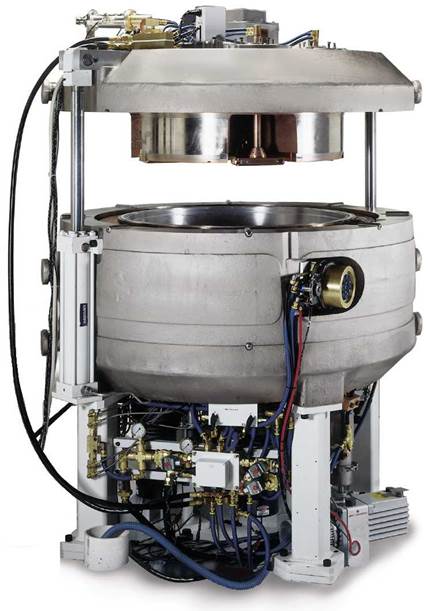
An 11 MeV cyclotron on site at CMGI (Siemens RDS111) produces F-18, C-11, and N-13 on demand.
CMGI Radiochemistry: A resource for PET Imaging
The Radiochemistry Facility is equipped for on-site production of radioisotopes and custom synthesis of radiotracers, to support PET imaging at UC Davis.
Cyclotron-produced PET isotopes
| ISOTOPE | HALF-LIFE | AVAILABILITY |
| F-18 | 110 minutes | Daily on demand |
| C-11 | 20 minutes | Daily on demand |
| N-13 | 10 minutes | Daily on demand |
Frequently used PET isotopes from third party suppliers
| ISOTOPE | HALF-LIFE | AVAILABILITY |
| Cu-64 | 12.7 hours | Weekly |
| Zr-89 | 78.4 hours | Weekly |
| I-124 | 100.3 hours | Weekly |
 Radionuclides are delivered directly to shielded hot cells, in which syntheses are performed. |
 Most F-18 and C-11 PET radiotracers are prepared in automated synthesis units. |

Remote manipulators are used for manual reactions.
PET Radiotracers Available at CMGI
The PET radiotracers below are readily available at CMGI; new tracers can be added at client request.
Routine PET Radiotracers
| PET RADIOTRACER | MECHANISM |
| [18F]FDG | Glucose metabolism |
| [18F]NaF | Osteogenic activity |
PET Radiotracers for Oncology
| PET RADIOTRACER | MECHANISM |
| [18F]FAZA | Hypoxia |
| [18F]FMISO | Hypoxia |
| [18F]Fluoroglutamine | Glutamine Metabolism |
| [18F]FLT | Cell proliferation |
PET Radiotracers for Neuroscience
| PET RADIOTRACER | MECHANISM |
| [11C]Raclopride | D2 Dopamine receptors |
| [11C]SCH23390 | D1 Dopamine receptors |
| [18F]FMT | DOPA Metabolism |
| [11C]GR103545 | Kappa opioid receptors |
| [11C]PK11195 | TSPO targeting for neuroinflammation |
| [18F]PBR111 | TSPO targeting for neuroinflammation |
| [18F]DPA-714 | TSPIO targeting for neuroinflammation |
| [11C]PiB | Beta-amyloid plaques in neuronal tissue |
| [11C]DASB | Serotonin receptors |
| [18F]UCB-H | Synaptic Vessel Glycoprotein 2A (SV2A) |
Miscellaneous/ Multiple Functionality
| PET RADIOTRACER OR RADIOCHEMICAL | MECHANISM |
| [18F]FHBG | Reporter probe for imaging HSV1-tk gene expression |
| [18F]FBA | Prosthetic group for peptide labeling |
| [18F]SFB | Prosthetic group for peptide labeling |
| [13N]NH3 | Cardiac perfusion |
| [64Cu]Cu-PTSM | Cell perfusion |
64 Cu-, 89 Zr-, and 124 I-radiolabeled targeting molecules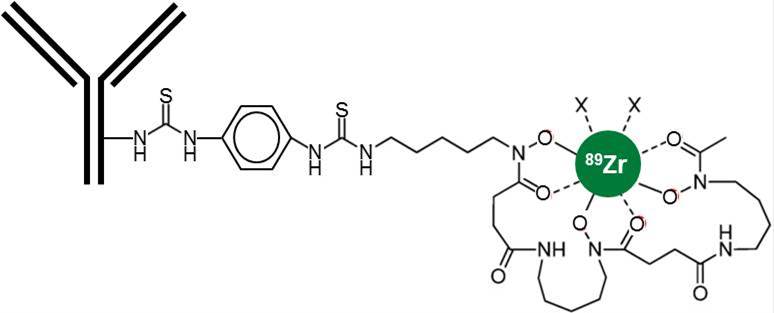 The longer half lives of Cu-64, Zr-89, and I-124 are well matched to targeting molecules with relatively slow biological clearance, such as antibodies and antibody constructs. At right isan example of a radiolabeled targeting molecule: in this case, an antibody radiolabeled with Zr-89 via the chelating (metal binding) moiety desferrioxamine. Analogous constructs can be prepared at CMGI, with targeting molecules conjugated to Cu-64 or Zr-89 chelates, or radiolabeled directly with I-124. |
|
Method Development of New PET Radiotracers
- Suggestions for new PET radiotracers for prospective studies are always welcome. CMGI regularly adds new tracers to its menu, most at client request.
- CMGI can provide an estimate for development time and expense; method development may take as little as 3-6 weeks.
- CMGI pilot grant funding may help to develop tracers of general interest, subject to availability and approval.